WWII - Axis Nuclear Weapons Conspiracy
Dr. Heisenberg or:
How I Learned Germany Had Nukes And So Did Japan
It's a bold statement to make. I believe there is an innate desire of people today to truly understand the kinds of things that Nazi Germany was up to during WWII. It's understandable; it was the largest, deadliest, and most costly war ever fought by man. The Nazis themselves, along with their leader Adolf Hitler, are some of the most fascinating and infamous people to ever have existed.
I'd argue it's an even more outrageous statement to make that Japan, of all countries, had nuclear weapons (Yes, that Japan, the one that fell victim to them in August 1945). Most people are not taught the Japanese side of WWII and many of their operations and projects have been reduced to footnotes in history books. Make no mistake that Imperial Japan, like Nazi Germany, had the ability to unleash very devastating things onto the world should they have chosen to.
But before we go any further, let me just say this: After enough research of my own, I cannot deny the idea that Nazi Germany not only had nuclear weapons in some form, but used them prior to the end of the War in Europe in May 1945. I also fully believe that Imperial Japan, like Nazi Germany, had access to nuclear weapons and in fact launched a successful nuclear test prior to the end of the War in the Pacific in August 1945.
Historical Context
As always, I believe it is important to understand the historical context and commonly accepted facts in order for you to understand before I speak of any theories.
In December 1938, German chemists Otto Hahn and Fritz Strassmann discovered nuclear fission. This discovery is considered the first major discovery of modern nuclear physics. Germany began their first Uranverein project in April 1939, in an effort to produce the first nuclear reactor. Not much would come of the first Uranverein, and it would be replaced by the second Uranverein project shortly after the outbreak of WWII in September 1939.
Due to the outbreak of WWII, many German research institutes were commandeered by the German military. Research on nuclear physics was essentially halted, although an effort led by Kurt Diebner and other nuclear physicists in Germany convinced the German military to allow further nuclear research. At this time, Werner Heisenberg stated that, with the input of other scientists, "in principle atomic bombs could be made, but they also emphasized that it would take a number of years." This knowledge was not conveyed to Adolf Hitler or Albert Speer (the Reichsminister for Armament) until several weeks later, and was not given in any urgent context as to not raise the hopes of any higher ups. Ultimately, German physicists did not believe a nuclear weapon could be built until 1943-1944. Germany did not expect nor intend for the war to last much longer than 1942, and so most development was sidelined throughout the war.
On the other side of the world, Imperial Japan was also experimenting with the nuclear discoveries of Germany. Japan's leading figure in nuclear development was Yoshio Nishina. Nishina was a key figure in the broader research of nuclear technology and was even responsible for introducing quantum physics to the Japanese world. Nishina had built his first cyclotron (a small particle accelerator) in 1938, and realised the military potential of nuclear fission in 1939. Nishina's primary worry was that the United States would develop a nuclear weapon before Japan and use it against them. At this time Japanese trust of West was very low and tensions were high which of course lead to war later in 1941.
Unlike Germany, who began their nuclear weapons project earlier in the fall of 1939, Japan did not begin such a program until 1941, when Japanese prime minister Hideki Tōjō ordered Nishina to explore the possibilites of developing a nuclear weapon. Like the Uranverein, the Japanese project would go through multiple iterations including: B-Research, Ni-Go Project, and F-Go Project.
August 1944 - Britain Prepares for Potential Nazi Nuclear Attack
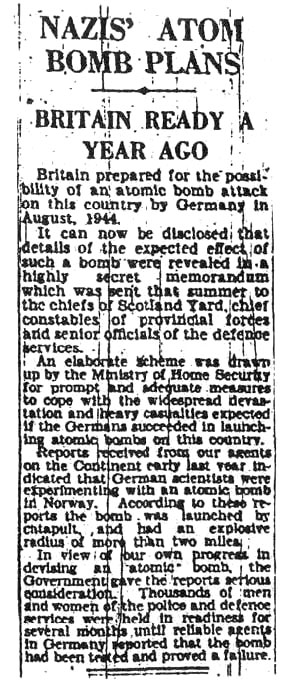
On August 11, 1945, an article was published in the London Daily Telegraph. The headline boldly declared "NAZI'S ATOM BOMB PLANS - BRITAIN READY A YEAR AGO". This article came 2 days after the bombing of Nagasaki and has since been lost to time. The article went into further detail stating how the British Ministry of Home Security had developed measures in August 1944 in anticipation of a nuclear attack on London by Germany. Of course, no nuclear attack ever took place but the British believed it was a real possibility. According to the article, reports had been made by British spies that nuclear developments in German-occupied Norway had lead to the testing of a nuclear weapon that had been "launched by catapult" and had an explosive radius of "two miles." The British police force and Home Defense Force were kept in a state of readiness until eventually British spies revealed that the nuclear test had been a failure.
To be honest, I do not know what to make of this article. I personally have not seen any evidence that corroborates these events as having happened. I have no doubt that the British establishment did in fact prepare for such an eventuality, as at that time, London was heavily defended with state of the art anti-air and radar systems, as well as deep subterrenean bunkers and bomb shelters. The issue with this article comes from the fact that there are no statements from the Axis powers regarding nuclear testing in Norway. However, I've included this section because I'm not willing to discount it entirely.
October 1944 - Rügen Island Weapons Test
On October 12th 1944, Italian war correspondent and respected journalist Luigi Romersa was ordered by Italian prime minister Benito Mussolini to attend a weapons test on the German island of Rügen. Rügen island is a small island in the north-east of Germany which was largely unpopulated at the time. The Germans had wanted to place a large Volkswagen manufacturing plant there but it never came to fruition.
While Romersa never used the word "nuclear" at any point, it is not a stretch to say that this weapon certainly was nuclear in some form or another. The explosion noted was very similar to that of the famous "mushroom cloud" produced by nuclear weapons and the use of asbestos-lined protective clothing also points towards the bomb being radioactive.
Romersa was quoted as having said:
"They took me to a concrete bunker with an aperture of exceptionally thick glass. At a certain moment, the news came through that detonation was imminent. [...] There was a slight tremor in the bunker; a sudden, blinding flash, and then a thick cloud of smoke. It took the shape of a column and then that of a big flower. [...] The officials there told me we had to remain in the bunker for several hours because of the effects of the bomb. When we eventually left, they made us put on a sort of coat and trousers which seemed to me to be made of asbestos and we went to the scene of the explosion, which was about one and a half kilometers away. [...] The effects were tragic. The trees around has been turned to carbon. No leaves. Nothing alive. There were some animals - sheep - in the area and they too had been burnt to cinders."
It should be noted that Romersa was a respected journalist as mentioned earlier. He was a close friend of German rocket scientist Werner von Braun and his visit to Rügen Island is documented and accepted as historical fact outside of any theories. He would later cover many incidents during the Cold War and was never considered unreliable or untrustworthy.
March 1945 - Explosions in Thuringia
On March 4th 1945, there were reports made by citizens of the Thuringian village of Ohrsdruf that some kind of weapon had been tested near the village at an abandoned army parade ground.
Clare Werner, a resident of Ohrsdruf, is quoted as having said:
"It was about 9:30 when I suddenly saw something [...] it was as bright as hundreds of bolts of lightning, red on the inside and yellow on the outside, so bright you could've read the newspaper. It all happened so quickly, and then we couldn't see anything at all. We noticed there was a powerful wind, then nose bleeds, headaches, and pressure in the ears."
The next day, an employee of a local excavating company, Heinz Wachsmut, was ordered by the SS to assist in building platforms to cremate the remains of 700 POWs that had been killed as a result of the explosion. Ohrsdruf was home to a sub-camp of the Buchenwald concentration camp and was responsible for forced labour. It is not out of the question to assume that the 700 POWs were being used for labour in the area when the explosion took place. The remains were horrifically burnt, and he corroborated Werner's statement that local residents were complaining of headaches and the coughing up of blood.
Rather interestingly, Ohrsdruf concentration camp is notable as having been the first concentration camp personally visited by Eisenhower. Captain Alois Liethen, a U.S. intelligence officer, had been ordered personally to investigate Ohrsdruf concentration camp, although the reason why is unknown. The general Ohrsdruf area also held other secrets, such as Nazi gold and treasures that had been hidden in salt mines and an abandoned Führerbunker. It also would've been one of the last areas of Germany under control in 1945 before it fell to the Allies on April 4th 1945.
August 1945 - Japan Tests Bomb - 5 Days Before War's End
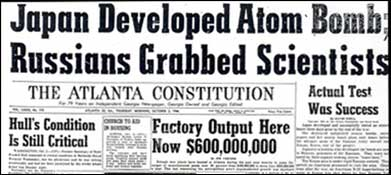
In 1946, the Atlanta Constitution newspaper published an article boldly declaring "Japan Developed Atom Bomb; Russians Grabbed Scientists."
Japan's nuclear weapons program was independent of Germany's. However in 1943 there was a diplomatic signal between the two countries in which they both realised eachother's progress. There is no doubt that the two immediately began sharing information regarding nuclear weapons development.
According to the article, the Japanese were able to test a nuclear weapon in Konan, Korea only 5 days before the war ended. The weapon had been developed in a cave and was transported by truck convoy to the coast. The bomb was loaded onto a disused ship and sent out to the sea on a timer. According to observers, the bomb detonated at a distance of 20 miles. It created a blinding ball of fire estimated to be of 1,000 yards (~500m) in diameter.
The Japanese understood that they did not have enough time to use a nuclear weapon as a deterrent against a possible invasion of the Japanese mainland by the United States. Those involved swiftly disassembled and destroyed any machinery and equipment left over from the production of the weapon, fearing the Soviet advance that would soon overcome Konan. According to the source of this information, a Japanese army officer, scientists and technicians were captured by Soviet forces as they completed their invasion of Korea.
Those who believe in mainstream thought will be quick to dismiss this one as debunked. However, I'm not so eager to do so. Imperial Japan destroyed many of their documents before the end of the war and many of their pursuits were hidden and in some cases not discovered until very recently. One piece of evidence they use to debunk this claim is that there is nothing to suggest a mass abduction of scientists from Korea before the war ended. I would make the very simple counter that it would of course be in the best interest of the United States to not admit that their rival had essentially stolen scientists capable of manufacturing a nuclear weapon (something only the United States had at that time). This isn't new, we know how they tried (and failed) at hiding the German scientists taken during Operation Paperclip and how they failed at hiding the German scientists abducted by the Soviets.
Axis Spies in the Manhattan Project
TBC
Were The Bombs Dropped on Japan Stolen From Germany?
Another question I often see asked is "Were the bombs dropped on Japan stolen from Germany?" It's a good question to ask, and it's honestly one I've tried to dig deeper into myself. Personally, I attribute it to the theory that the United States were able to develop a weapon of their own (The Fat Man), but the second bomb (Little Boy) was in fact stolen from Germany.
The Little Boy was named as such because it wasn't as powerful as the previous Fat Man. Officially, we are led to believe that they simply didn't have enough materials left over from the first bomb, to produce an adequate second bomb but this leaves a lot for interpretation. One could argue that perhaps the reason this bomb wasn't as powerful was because Germany didn't have the same level of technology. Could the Little Boy have been made from the same material as the proto-nuclear weapons we saw in places like Rügen Island and Thuringia?
We're told that the drop of the Little Boy was essentially a bluff. The United States wanted Japan to think that they had enough bombs to drop every few days or weeks, essentially a psychological warfare method to encourage them to surrender. I seriously question this, why drop a clearly less powerful bomb the second time? Nishina had already examined the first atomic blast on Hiroshima, and surely he would've been able to tell that this second bomb was worse. However, it would make more sense that the bomb dropped on Nagasaki wasn't American at all but, in fact, German and that it was dropped not for any strategic purpose but rather to test if the Germans had in fact managed to manufacture a working nuclear weapon. I mean why even make and drop two bombs at all? The atom bomb was, and still remains to this day, the ultimate weapon developed by man, a card nobody is willing to play. If the United States wanted to make their statement, they only needed one bomb to do so.